1.3 Properties of concrete
In the concrete properties, define the concrete type, concrete class and concrete state diagram. It is possible to set coefficients for concrete strength. By default, the recommended values for the selected normative document are set.
Accidental eccentricities are defined in order to increase the moments, taking into account the second order effects in eccentrically compressed bar elements. The minimum accidental eccentricities are calculated automatically.
Stress-strain diagram
The parabolic-rectangular diagram or the bilinear diagram is chosen as the design diagram for the state of compressed concrete by paragraphs 3.1.7 (1) and 3.1.7 (2) of SP RK EN 1992-1-1:2004/2011. These diagrams show how stresses and relative strains relate to one another.
Relative air humidity
The relative humidity (%) is defined to determine the nominal free shrinkage on drying of concrete with CEM cement of class N by clause 3.1.4 (6) of SP RK EN 1992-1-1:2004/2011.
αct - coefficient taking account of long term effects (tension)
According to clause 3.1.6 (2) of SP RK EN 1992-1-1:2004/2011, a coefficient αct is defined to take into account the long term effects on the tensile strength and the unfavourable effects resulting from the way the load is applied.
Conversion factor η to reduce γc based on testing in a finished structure or element
For concrete strength values that are based on testing in a finished structure or element, the partial safety factor γc may be reduced by conversion factor η. See clause A.2.3 (1) of SP RK EN 1992-1-1:2004/2011.
Coefficients which limit the stress
According to clauses 7.2 (2) and 7.2 (3) of SP RK EN 1992-1-1:2004/2011, the coefficients for analysis by serviceability limit states are as follows: k1, which limits compressive stresses in concrete, and k2, which limits compressive stresses in concrete during creep (which controls the choice of creep model). The recommended values are 0.3...1.
Creep coefficient
The final value of creep coefficient φ(∞, tn) is defined according to clause 3.1.4 (5) of SP RK EN 1992-1-1:2004/2011.
αcc - coefficient taking account of long term effects (compression)
According to clause 3.1.6 (1) of SP RK EN 1992-1-1:2004/2011, a coefficient αcc is defined to take into account the long term effects on the compressive strength and of unfavourable effects resulting from the way the load is applied. By default, αcc is taken as equal to 0.85, for emergency combinations - as 1.2, for earthquake combinations - as 1. In analysis by serviceability limit states, it is always taken as equal to 1. The recommended values are 0.8...1.
γc - safety factor
The partial factor (safety factor) for concrete γc for persistent and transient (long-term and short-term) design situations is defined according to clause 2.4.2.4 (1) of SP RK EN 1992-1-1:2004/2011. By default, γc is taken as equal to 1.5, for emergency and earthquake combinations - as 1.2, for analysis by serviceability limit states (check for cracks) - as 1. The recommended values are 1...2.
Accidental eccentricities (bar)
Accidental eccentricities in two directions of the section in the X1OZ1 (EY, moment My) and X1OY1 (EZ, moment Mz) planes are defined.
Exact geometrical parameters in design
Option to modify the partial safety factor for materials in case there are accurately measured dimensions; see clause A.2.2 SP RK EN 1992-1-1:2004/2011.
First order effects (Geometric imperfections)
Option to take into account the first order effects (unfavourable effects without taking into account the strain of the structure, but with account of geometric imperfections), see clause 5.2 of the SP RK EN 1992-1-1:2004/2011.
Second order effects
Option to take into account the second order effects (additional unfavourable effects due to strain of the structure), see clause 5.1.4 of the SP RK EN 1992-1-1:2004/2011. In the list, select for which calculations they should be taken into account (Stiffness+Curvature, Stiffness, Curvature).
Table of design parameters
For the selected concrete class, the normative and design parameters are displayed:
- E_cm - modulus of elasticity;
- f_ck - characteristic compressive cylinder strength of concrete at 28 days;
- f_ck_cube - characteristic cube compressive strength of concrete at the age of 28 days;
- f_cm - mean value of concrete cylinder compressive strength;
- f_ctm - mean value of axial tensile strength of concrete;
- f_ctk_005 - characteristic axial tensile strength of concrete;
- (other).
The table may be modified for additional, user-defined classes of concrete.
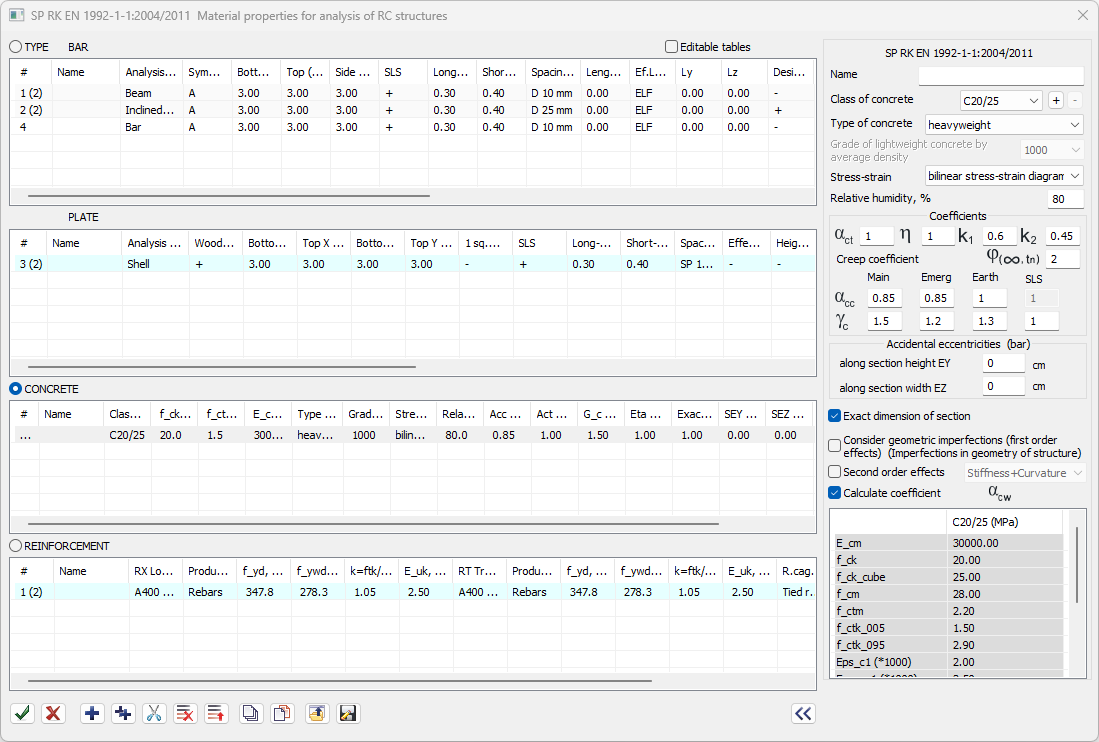
Materials: concrete