Criteria by DCF for bars
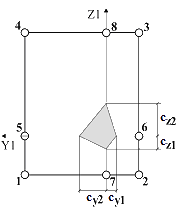
The extreme values of normal and shear stresses calculated at certain points of the reduced rectangular cross-section as well as the extreme values of forces in the cross-section are taken as dangerous criteria of the DCF for bars.
For normal stresses, the following formula is applied:
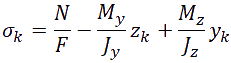
where k Ö the point of bar section (k = 1...9).
This formula is converted as follows when
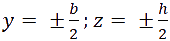 :
:
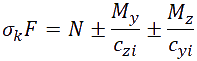
where cyi and czi Ö core distances in the core cross-section (i = 1,2). This approach makes it possible to determine the extreme normal stresses in ANY cross-section and reduce the cross-section to a rectangular shape.
For the shear stresses, an approximate formula is applied:

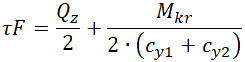
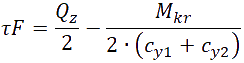
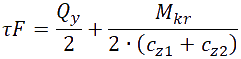
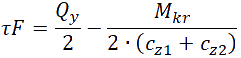
The stresses calculated by formulas (2) and (3) are displayed in Table 1 for each point of the section. The sign convention for the forces is applied.
Table 1. Formulas for calculating the stresses at the points of rectangular cross-section.
|
Section point No.
|
Normal stress
|
Shear stress
|
|
1
|

|
-
|
|
2
|

|
-
|
|
3
|

|
-
|
|
4
|

|
-
|
|
5
|

|
|
|
6
|

|
|
|
7
|

|
|
|
8
|

|
|
In addition to the normal and shear stresses, the extreme values of the following parameters are calculated: the longitudinal force and each of the shear forces, horizontal and vertical reactions of the elastic foundation, the bending moments.
46 DCF values are selected for the bar section.
The numbers for DCF criteria for the bars and the corresponding stresses and forces are presented in Table 2.
Table 2. DCF criteria for bars
|
Criterion No.
|
1
|
2
|
3
|
4
|
5
|
6
|
7
|
8
|
9
|
10
|
11
|
12
|
|
Value
|
σ1+
|
σ1-
|
σ2+
|
σ2-
|
σ3+
|
σ3-
|
σ4+
|
σ4-
|
𝜏7+
|
𝜏7-
|
𝜏8+
|
𝜏8-
|
|
Criterion No.
|
13
|
14
|
15
|
16
|
17
|
18
|
19
|
20
|
21
|
22
|
23
|
24
|
|
Value
|
𝜏5+
|
𝜏5-
|
𝜏6+
|
𝜏6-
|
N+
|
N-
|
σ7+
|
σ7-
|
σ8+
|
σ8-
|
σ5+
|
σ5-
|
|
Criterion No.
|
25
|
26
|
27
|
28
|
29
|
30
|
31
|
32
|
33
|
34
|
35
|
36
|
|
Value
|
σ6+
|
σ6-
|
Qy+, N+
|
Qy-, N+
|
Qy+, N-
|
Qy-, N-
|
Qz+, N+
|
Qz-, N+
|
Qz+, N-
|
Qz-, N+-
|
Ry+
|
Ry-
|
|
Criterion No.
|
37
|
38
|
39
|
40
|
41
|
42
|
43
|
44
|
45
|
46
|
-
|
-
|
|
Value
|
Rz+
|
Rz-
|
My+
|
My-
|
Qz+
|
Qz-
|
Mz+
|
My-
|
Qy+
|
Qy-
|
-
|
-
|
DCF criteria for plates
For elements of plane stress state, plates and shells, the stresses determined by Wood-Armer method according to the following formulas are taken as the criterion:
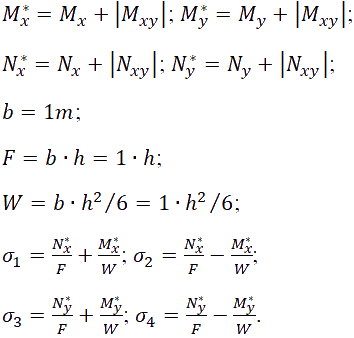
The numbers for DCF criteria for the plates and the corresponding stresses are presented in Table 3.
Table 3. DCF criteria for plates
|
Criterion No.
|
1
|
2
|
3
|
4
|
5
|
6
|
7
|
8
|
9
|
|
Value
|
σ1+
|
σ1-
|
σ2+
|
σ2-
|
σ3+
|
σ3-
|
σ4+
|
σ4-
|
Nx*+
|
|
Criterion No.
|
10
|
11
|
12
|
13
|
14
|
15
|
16
|
17
|
-
|
|
Value
|
Nx*-
|
Ny*+
|
Ny*-
|
Qx+
|
Qx-
|
Qy+
|
Qy-
|
√(Qx2+Qy2)
|
-
|
DCF criteria for solids
The extreme stress values are considered as criterion for determining DCF for solids. The numbers of the criteria and the corresponding stresses are presented in Table 4.
Table 4. DCF criteria for solids
|
Criterion No.
|
1
|
2
|
3
|
4
|
5
|
6
|
7
|
8
|
9
|
10
|
11
|
12
|
|
Value
|
Nx+
|
Nx-
|
Ny+
|
Ny-
|
Nz+
|
Nz-
|
Txy+
|
Txy-
|
Txz+
|
Txz-
|
Tyz+
|
Tyz-
|
DCF criteria for special FE
The extreme force values are considered as criterion for determining dangerous combinations in special elements (one-node FE 51, 56 and two-node FE 55).
For FE 51, 55 and 56, the numbers of the criteria are accepted from 1 to 12, they correspond to the force indexes in the FE.
For the out-of-contour elements of soil (FE 53, 54), the DCF are not calculated.