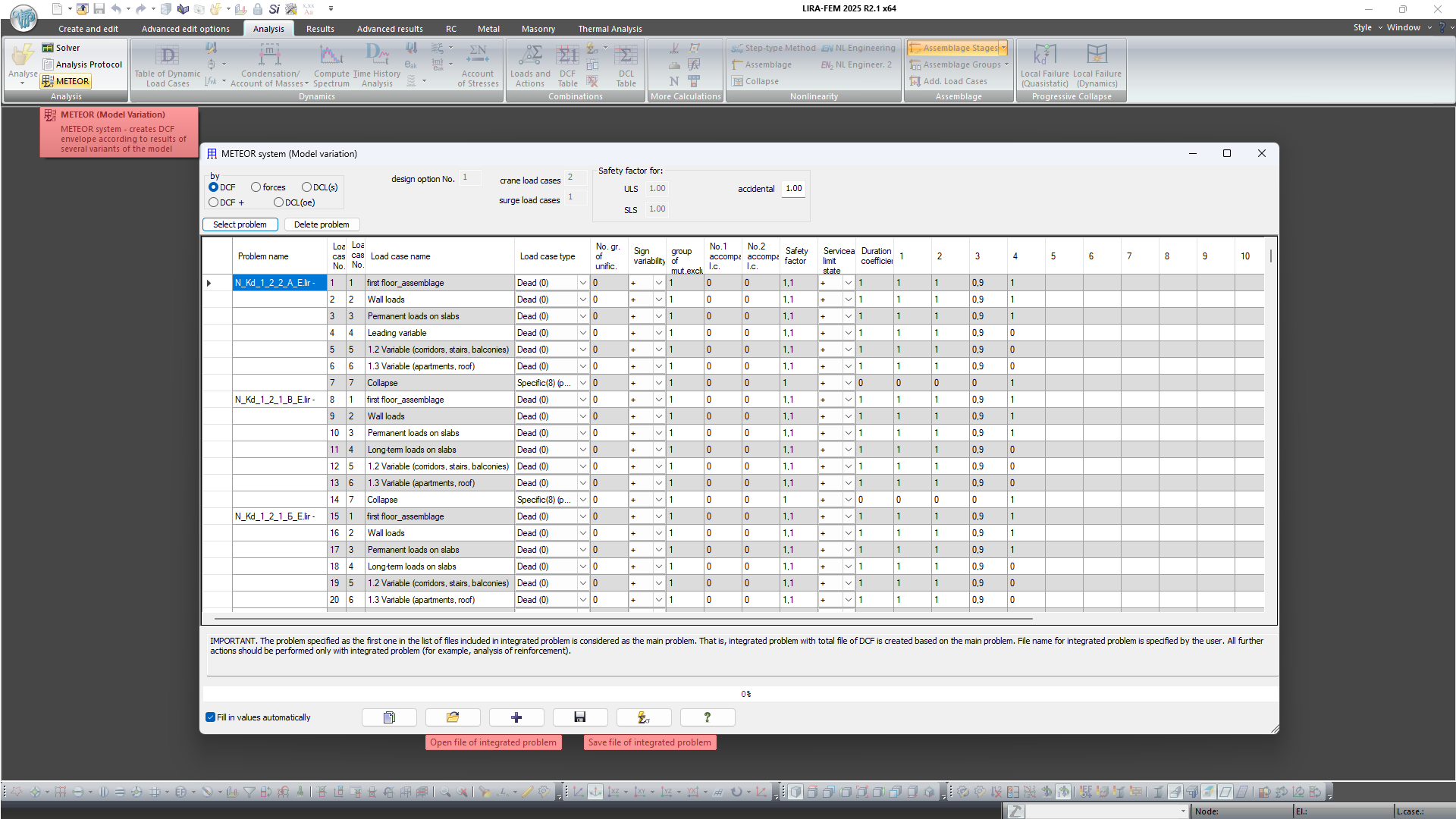
METEOR (Method for a Unified Generalized Result) is a subsystem designed to combine the analysis results of several design models with the same topology into a single generalized result.

Basic principles

  • All models must have the same topology: geometry, number and types of elements.
  • Differences in loads, stiffnesses, boundary conditions, soil parameters, and dynamic effects are allowed.
  • The internal forces in element cross-sections must remain consistent, although the number of load cases may differ.

The integrated task created in the METEOR system contains the base topology, stiffnesses, and analysis results of all combined models. On this basis, unified load combinations of internal forces (LCF) are calculated, serving as the basis for design according to the specified options.

The system supports several integration methods

  • based on LCF – unification of load combinations with the selection of extreme values for each criterion across all tasks;
  • based on LCF+ – an extended mode: unification of load combinations with the ability to freely combine static and dynamic tasks, including time-history dynamics. Allows combining linear and nonlinear tasks in a single package;
  • based on internal forces – load combinations are calculated as in a regular task, but for a consolidated list of load cases across all tasks;
  • based on DLC(f) and DLC(fe) – when combination is performed according to governing design loads in line with the applicable codes.

Working with the METEOR system is organized through building a task package. The user can add or remove tasks, automatically read load information, and change parameters in the source table. For convenience, it is possible to attach a generalized task file (*.t8m) to the current list of models.
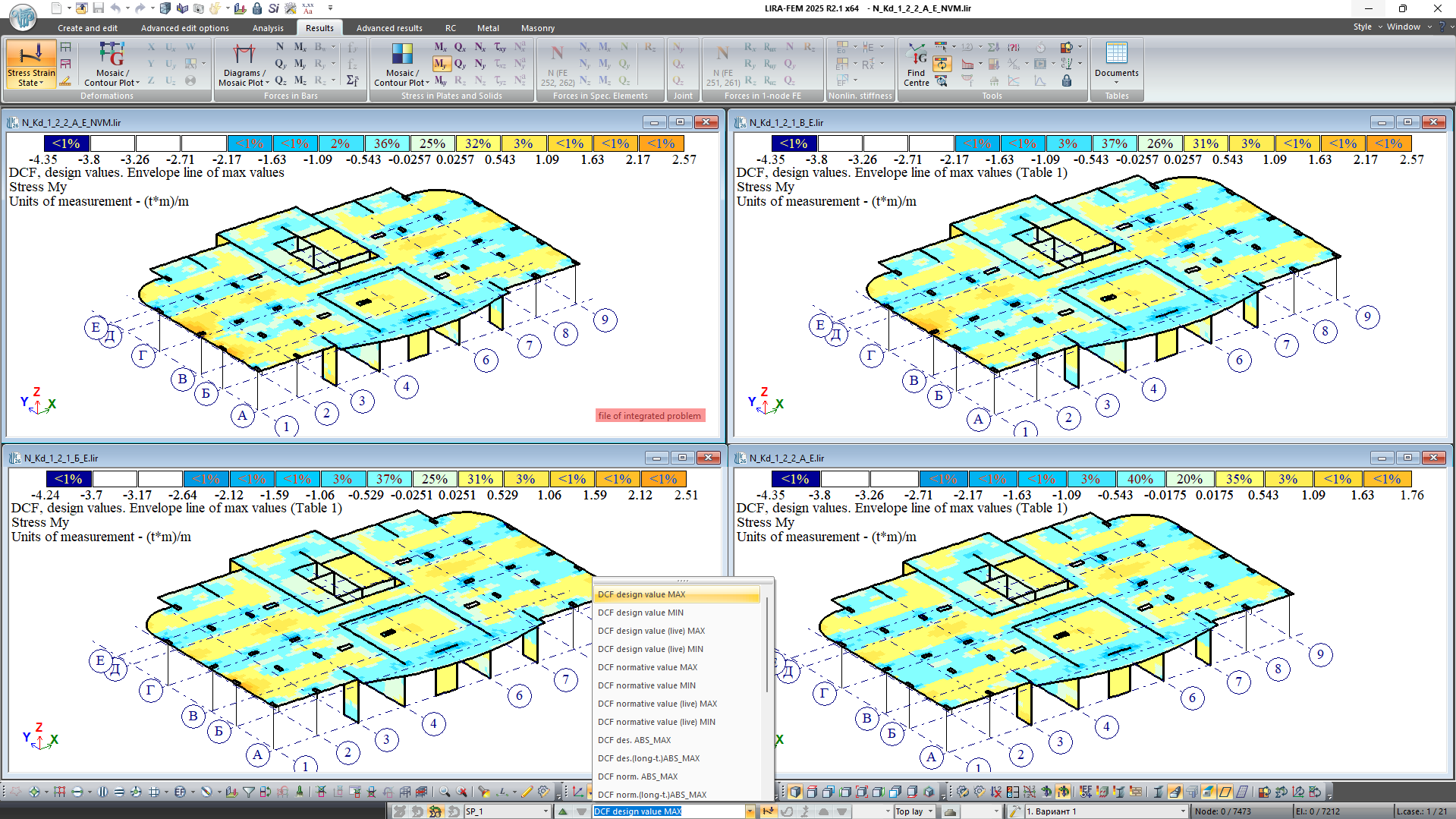
Once the results have been calculated, you can view envelope diagrams and bimoment mosaics, allowing you to quickly assess the structure's stress-strain state.

For example

A single finite element model is created for all tasks.

  • In the first task, an analysis is performed for permanent and long-term loads
  • In the second task – an analysis for seismic and wind effects with modified subgrade properties (subgrade moduli C1 and C2)
  • In the third – an analysis for specified displacements (undermining, settlement)

The user creates an integrated task to obtain unified load combinations across these three tasks.

In this way, METEOR is a universal task-integration system that extends the capabilities of the former "Model Variation" subsystem, enabling a more complete and flexible analysis of structures under various operating conditions.

Evaluate the software

If you have any doubt, download the Demo version and evaluate the program or contact our Support Team for more details.

Demo version or Request online presentation