The assemblage of building structures is a complex, multi-stage process during which a structure passes through a series of intermediate states, each accompanied by a change in the design model and a redistribution of forces and deformations. Ignoring these stages can lead to significant errors in determining the stress-strain state, both during construction and in service.

The Assemblage system within LIRA-FEM enables full computer modeling of the structure assemblage process: from defining the sequence of assemblage stages to obtaining the final stress-strain state with accumulated stresses taken into account. The system supports both assemblage and dismantling of structural elements, making it possible to model real-world construction, reconstruction, and demolition scenarios.

Assemblage Stages in LIRA-CAD
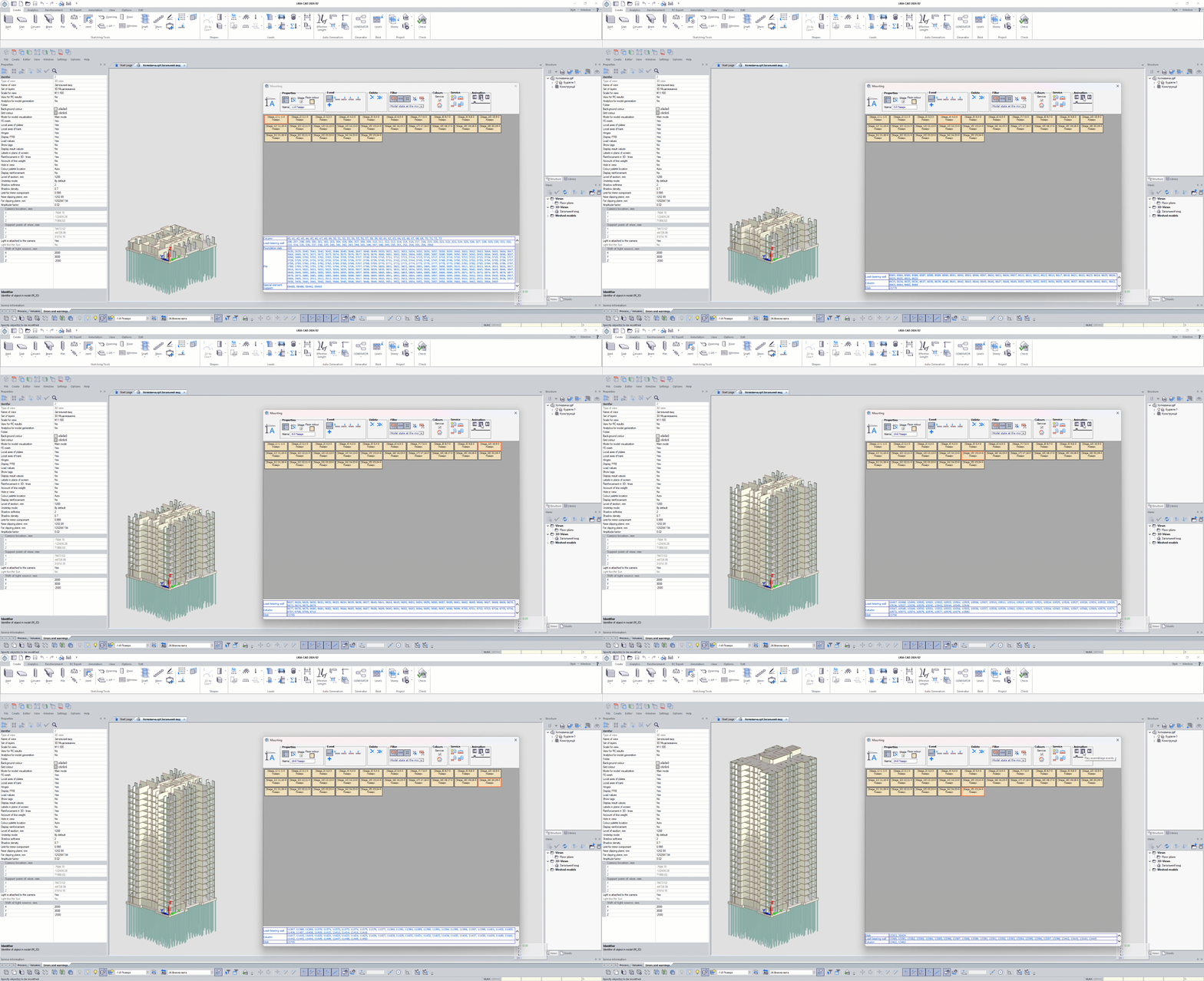
LIRA-CAD provides convenient tools for defining the assemblage sequence of structures directly within the BIM design environment. Assemblage stages can be created automatically or manually, depending on the complexity of the object and the analysis requirements.

Generating assemblage stages:

  • by floor — for typical multi-story buildings;
  • by individual structural elements and loads — for detailed modeling of non-typical or complex structural schemes.

Adjusting the assemblage sequence:

After the stages have been generated automatically, the engineer can manually adjust the assemblage sequence of individual elements in accordance with the actual construction schedule.

Load classification:

For each load, its association with a specific assemblage stage is defined, or its status as post-stage — that is, applied only after the structure's assemblage has been completed.

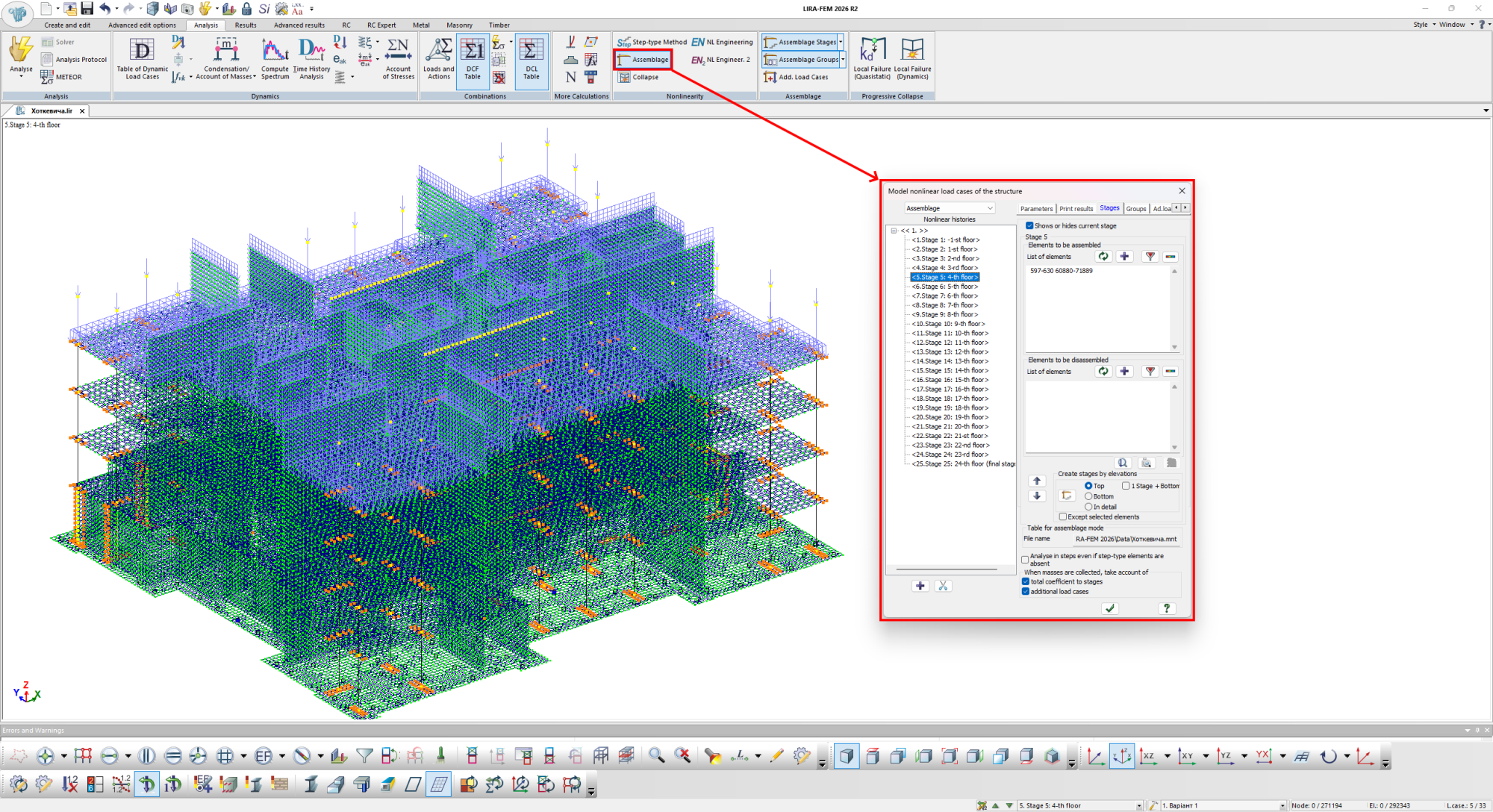
The source data prepared in LIRA-CAD is transferred to LIRA-FEM, where the model is analyzed directly, taking staged assemblage into account. After the transfer, the data remains flexible — LIRA-FEM allows editing, adding, or removing assemblage stages to refine the design model without needing to return to LIRA-CAD.
Assemblage Stages in LIRA-FEM

In addition to editing the transferred stages, LIRA-FEM also supports independently creating assemblage stages — automatically by elevation marks, or manually by selecting the required finite elements.

Manually selecting finite elements is especially useful for solving specific problems — for example, modeling progressive collapse of a structure due to sudden impact loads or local failures, where the dismantling stage does not follow the typical assemblage logic and requires pinpoint definition of the elements to be excluded from the design model.

Analysis

Once all the source data has been specified, the analysis is performed using the nonlinear solver, which correctly accounts for changes in the design model, redistribution of forces, and accumulation of deformations at each stage of Assemblage (or dismantling) of the structure.

Results

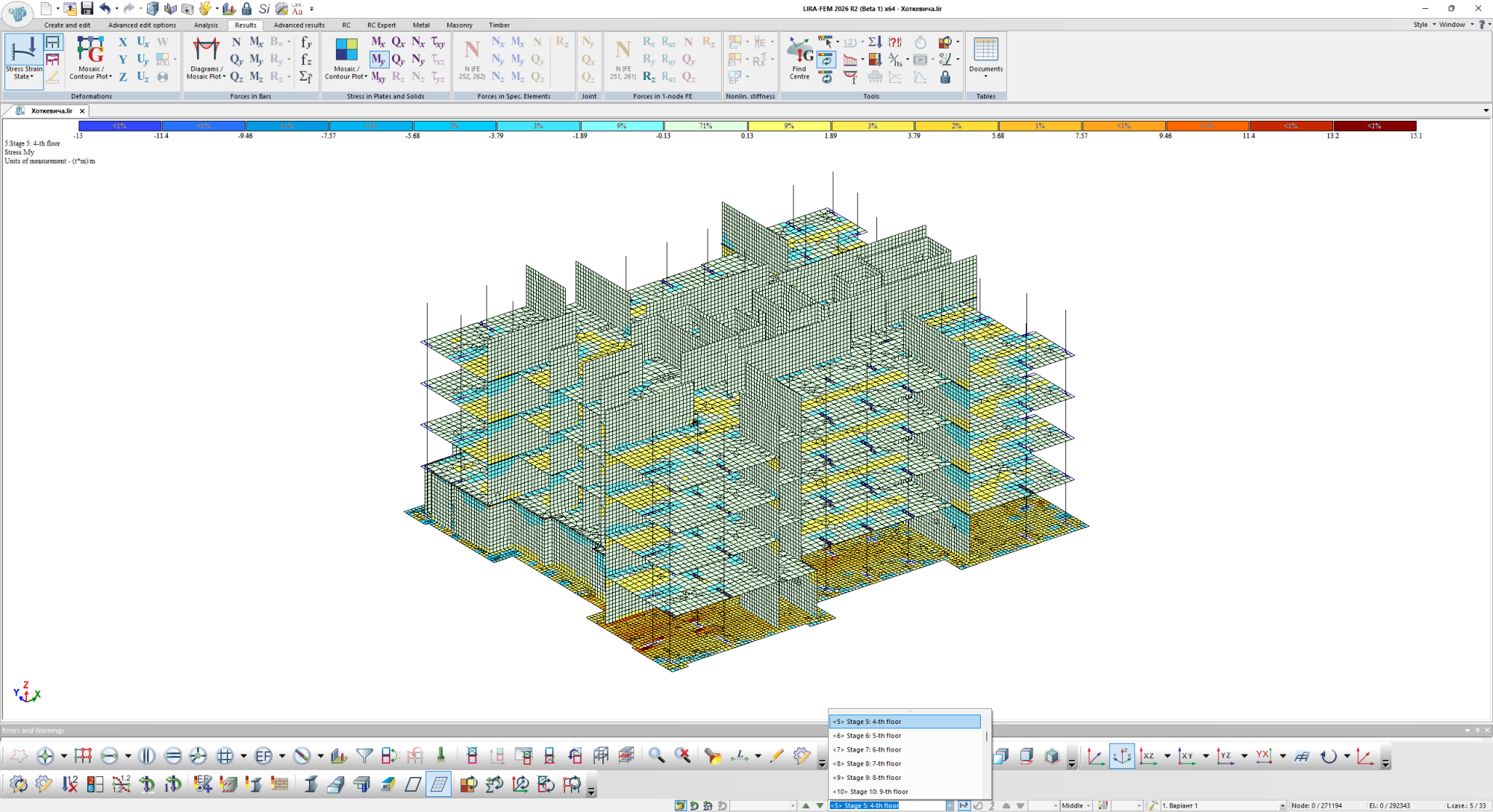
The analysis results provide the stress-strain state (SSS) of the building model after each Assemblage or dismantling stage, making it possible to track the structure's behavior throughout its entire life cycle — from assemblage to possible off-design impacts.

Evaluate the software

If you have any doubt, download the Demo version and evaluate the program or contact our Support Team for more details.

Demo version or Request online presentation